The advent of generative AI has contributed to increased dispersion as the market attempts to distinguish between winners and losers. There are three themes here that will matter for investors over the coming years.
First, companies involved in the development of AI data centers are benefiting enormously. This group captures the most headlines for bringing billions of dollars into seemingly endless new projects. Nvidia, the most important arms merchant, has become the world’s most valuable company. The challenge for investors is that a lot of money has already been made, and the risk of excesses is growing. Forecasts are heady, capacity additions are massive, and the financial engineering to pay for it all is becoming increasingly creative. Eagle has participated in this value chain to a degree, but we are generally not deploying incremental capital here.
Second, we believe there is a rich and growing opportunity to invest in AI diffusion winners as the technology is deployed in novel and valuable ways. OpenAI is the archetypal example of this, but many are more subtle. Eagle’s recent investment in Danaher is partially predicated on a view that enhanced drug discovery will be a tailwind to its business. UnitedHealth Group can improve patient satisfaction while reducing costs by effectively deploying generative AI. Excellent risk-adjusted opportunities exist in this category if we can buy optionality inexpensively.
Third, we are on the hunt for “AI confusion” opportunities. Plenty of businesses will be on the wrong side of this creative destruction, and we seek to avoid them structurally. There will also be firms that are misunderstood. Perhaps they have a superficial AI-driven bear case or a cyclical slowdown that is perceived as the AI bogeyman. At times, there may be a legitimate risk to 20% of a given business, but upside across the other 80%.
One analog of this dynamic from a recent innovation cycle is Amazon’s success in disrupting multiple industries. Many direct retail competitors were destroyed. Yet some companies branded as “Amazon losers” have proven to be anything but. In 2017, the stocks of several auto parts retailers declined by almost 50% amid concerns that Amazon would hurt their businesses. That prediction proved wrong, and those stocks have been highly profitable investments over the subsequent eight years.
As an example of what we’re finding in this third opportunity set, we present the London Stock Exchange Group (LSEG).
LSEG is a conglomerate of high-quality financial data and market infrastructure businesses. We think these assets will allow the company to grow revenue in the mid-to-high single digits for the foreseeable future.
Additionally, LSEG is exiting a multi-year investment cycle following its 2021 acquisition of the data and analytics company Refinitiv. As margins expand, we expect EBIT to grow in the low double digits and EPS in the mid-teens, bolstered by increased share buybacks. Paying a high-teen multiple of 2026 earnings is an attractive proposition for a business with this level of growth combined with low economic volatility.¹
Despite its name, the London Stock Exchange itself is less than 3% of revenue. LSEG has four business segments:
• Data & Applications (~45% of revenue)
• Markets (~40% of revenue)
• FTSE Russell (~10% of revenue)
• Risk Intelligence (~5% of revenue)
Data & Applications has two principal business units, each roughly half of segment revenue. The first is desktop terminals, similar to Bloomberg or FactSet. The other is data feeds, offering a variety of data products to financial institutions. LSEG’s primary data product is the real-time feed, which provides live pricing and order book data for hundreds of thousands of financial instruments.
These data products are mission-critical for customers. They are also hard to replicate. Desktop terminal users become accustomed to specific products and are reluctant to switch. The real-time feed connects to over 500 execution venues and distributes data via one of the world’s largest content delivery networks. This data supports trading and risk management activities across global banks and market makers.
The Markets business houses execution and clearing venues. The key businesses here are the London Clearinghouse (LCH) and LSEG’s 51% ownership of Tradeweb. The segment also includes the London Stock Exchange and several FX trading venues.
LCH is a leading clearinghouse for over-the-counter derivatives, particularly focused on interest rate swaps. Clearinghouses are a vital part of market infrastructure. In this role, LCH acts as the counterparty for both sides of these trades, setting margin levels for market participants and creating a clean view of risk exposures across this massive ecosystem. For context, LCH cleared $436 trillion in notional rate swaps —nearly 4x global GDP —in Q2 2025 alone.
LCH is a natural monopoly. Collateral charges are the primary cost of derivatives trading, and it is more collateral-efficient to clear an entire derivatives portfolio via a single clearinghouse than to do so across multiple. As a result, LCH has over 90% market share in clearing interest rate swaps. This is similar to the strong share performance realized in other derivatives markets such as CME’s interest rate futures franchise.
Tradeweb is the leading electronic fixed income trading platform. Historically, fixed-income securities such as sovereign government debt, corporate bonds, and credit derivatives were traded via phone. Electronic trading makes it easier to solicit bids or offers from multiple counterparties, leading to narrower spreads. For this reason, equity trading has been almost completely electronic for decades. As a more fragmented, less liquid market, fixed income has been slower to transition and has required bespoke trading protocols.
Tradeweb benefits from ongoing trends in fixed-income electronification and from scale as the largest pool of liquidity in the market, with the most capacity to invest in new protocols.
FTSE Russell is a financial index business. Its key intellectual properties are the FTSE family of international equity benchmarks and the Russell family of US equity benchmarks. Active and passive asset managers pay fees to use the underlying data of these benchmarks.
Indices are among the highest quality businesses in the world. Asset owners need benchmarks to evaluate performance and frequently specify the benchmark to be used for specific mandates. Indices incur low creation costs, exhibit strong returns to scale, and have high switching costs. They are a toll road on financial markets, charging comparatively small fees to ensure huge asset pools are managed appropriately.
Risk Intelligence offers data products used in risk and compliance functions. LSEG’s primary product, WorldCheck, is used by banks to determine whether individuals or corporate entities pose elevated Know Your Customer (KYC), Anti-Money Laundering (AML), or sanctions risks. Risk Intelligence supports key compliance processes for customers, charging little compared to the significant fines it helps prevent.
LSEG has assembled a portfolio of strong businesses that should grow faster than the overall economy. Data & Applications will be on the slower end as the desktop terminal market is mature. Markets, FTSE Russell, and Risk Intelligence should grow more quickly.
Revenue is also highly resilient. LSEG has a mix of recurring stable businesses (Data & Applications), businesses that benefit from rising markets (FTSE Russell), and businesses that benefit from market volatility via elevated trading activity (Markets).
LSEG is at an interesting point in its corporate history. In 2021, the company’s $27 billion acquisition of Refinitiv united Data & Applications, Risk Intelligence, and Tradeweb with LSEG’s historical indexing and clearing businesses. After this deal, LSEG embarked on a significant investment program, allocating over $1 billion per year to modernize Refinitiv’s infrastructure. These efforts have already borne fruit. LSEG’s desktop terminal business transitioned from decline to growth as a rebuilt terminal product reduced user churn. We expect ongoing product innovation across areas such as Generative AI to further enhance LSEG’s portfolio.
LSEG is well-positioned to expand margins over time via fixed cost leverage. The company currently has approximately 47% EBITDA margins, but has nearly 70% incremental EBITDA margins given low marginal costs. As LSEG grows, this dynamic should pull the former higher. Technology investments are moderating as a percent of revenue, lowering capital intensity and depreciation over time. All up, we think LSEG’s 37% EBIT margins can move closer to peer levels in the mid-to-high 40s.
We are also impressed with management. They have a thoughtful strategic vision, have executed well on a significant investment program, and are strong capital allocators. The team has done a good job balancing organic investments with returning capital to shareholders.
LSEG trades at 18x our estimate of 2026 earnings, below peer multiples despite comparable or faster earnings growth. We expect LSEG’s EPS to grow in the mid-teens over the next five years.
Layer on a 1.5% dividend yield and some multiple re-rating into the low 20’s, and we expect a ~20% multi-year IRR.
LSEG’s stock is down 24% year-to-date. We believe the decline is primarily due to market concerns about the impact of generative AI on the company’s business model. This mostly pertains to LSEG’s desktop segment, given the launch of products such as Claude for Financial Services.
We think the market is assigning an overly high probability of a negative outcome and underestimating the potential benefits the company may gain from AI.
LSEG’s business is diversified and resilient. 70% of LSEG’s desktop revenue is from traders, who require complex workflows and analytical modeling that AI is unlikely to significantly disrupt. Between the ~15% of LSEG’s desktop revenue tied to equity research and some data products that AI could potentially devalue over time, we estimate that about 10% of LSEG’s total EBITDA is at risk. Even if this were to decline by 50% over 5 years —a steeper decline than we believe plausible —the net impact would be EBITDA growing 1% more slowly than in our base case.
In fact, we believe it is more likely that LSEG benefits from AI. Large language models have significant potential to reshape financial institutions, but they will require large volumes of accurate financial data to do so. As a leading data provider, LSEG is well-positioned to monetize that incremental demand. We anticipate LLMs acting as a form of enhanced distribution for LSEG’s intellectual property. The company’s recent partnership with Microsoft is an example of this opportunity.
We approach predicting the impact of a rapidly evolving technology like AI with humility. Still, we believe the skew around LSEG is increasingly in our favor, and as a result, we have increased our position size this year.
Management and the board appear to share this view. Recently, there has been both insider buying and an increase in the company’s pace of share buybacks.
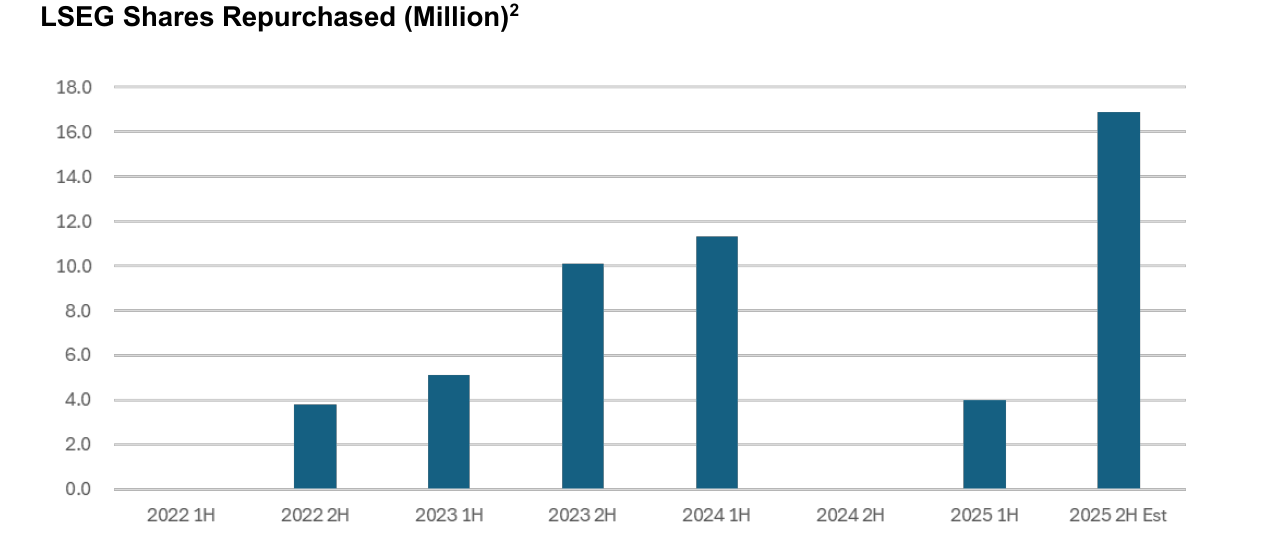
We expect to continue exploring opportunities in both AI diffusion and AI confusion, such as LSEG. With the overall market setting new highs, it’s more crucial than ever to exploit dispersion by recycling capital into investments with better risk/reward profiles. Our ongoing focus is the pursuit of attractive long-term absolute returns. We thank you for your support and trust.
As always, if you have any questions or would like to discuss anything herein, please call us at (212) 293-4040. Also, if your financial situation or investment objectives have changed, if your IPO eligibility or U.S. Person status has changed, or if you would like to modify or discuss any investment restrictions or guidelines, please reach out to your contact on the client team or email ClientServices@eaglecap.com.³
1 LSEG valuation, year-to-date performance, and IRR metrics are based on the 9/30/2025 price.
2 Source: Eagle Capital analysis based on the company’s regulatory filings and management guidance.
3 Eagle Equity Composite holdings during Q3 2025 were as follows: AA; AER; AMZN; AON; ASML; BAYRY; CHTR; CMCSA; COF; COP; DHR; EL; ELV; GEV; GLIBA/K; GOOG/L; HLT; HUM; INTU; LBRDA/K; LEN; LNSTY; META; MLM; MSFT; PTC; SAFRY; SAP; SHEL; TSM; UNH; VMC; WDAY; WFC; and WWD. The following entities are not currently held in the Eagle portfolio, and reference to these entities is included solely for informational and discussion purposes: Nvidia, OpenAI and Tradeweb.
Past performance is not indicative of future results, and there is no assurance that Eagle Capital’s investment objectives will be achieved or that the strategies employed by Eagle Capital will be successful. Except where otherwise indicated, the information contained in this content is based on matters as they exist as of the date of preparation of such material and not as of the date of distribution or any future date. This document does not constitute an offering of advisory services or advice or a recommendation or offer to sell or a solicitation to deal in any security or financial product in any jurisdiction. It is provided for informational purposes only and on the understanding that the recipient has sufficient knowledge and experience to be able to understand and make their own evaluation of the content described herein, any risks associated therewith and any related legal, tax or other material considerations. Recipients should not rely on this material in making any future investment decision. To the extent that the reader has any questions regarding the applicability of any specific issue discussed above to their specific portfolio or situation, clients and prospective investors are encouraged to contact Eagle Capital as well as to review other materials produced by Eagle Capital (including those available at eaglecap.com). Discussions herein relating to risk or any efforts to mitigate risk do not imply that any actions taken by or investment strategies employed by Eagle Capital are in any way low risk or risk free.
This document expresses the views of Eagle Capital as of the date indicated and such views are subject to change without further notice. Eagle Capital has no duty or obligation to update the information contained herein. Certain information contained in this content constitutes “forward-looking statements,” which can be identified by the use of forward-looking terminology such as “may,” “will,” “should,” “expect,” “anticipate,” “project,” “estimate,” “intend,” “continue,” or “believe,” the negatives thereof, other variations thereof or other comparable terminology. Due to various potential risks, uncertainties or actual events, the results or the actual performance of Eagle Capital’s investments may differ materially from those reflected or contemplated in such forward-looking statements.
Any discussion of specific companies contained herein is for informational purposes only and does not represent all of the securities purchased, sold or recommended by Eagle Capital. The reader should not assume that any investments in the securities identified and discussed herein were or will be profitable.
Q3 2025 Letter: The Quiet Toll Roads of… | Eagle Capital Management
From derivatives clearing to the FTSE Russell indexes, the London Stock Exchange Group owns essential infrastructure with high switching costs and scale advanta