Article
June 12, 2026
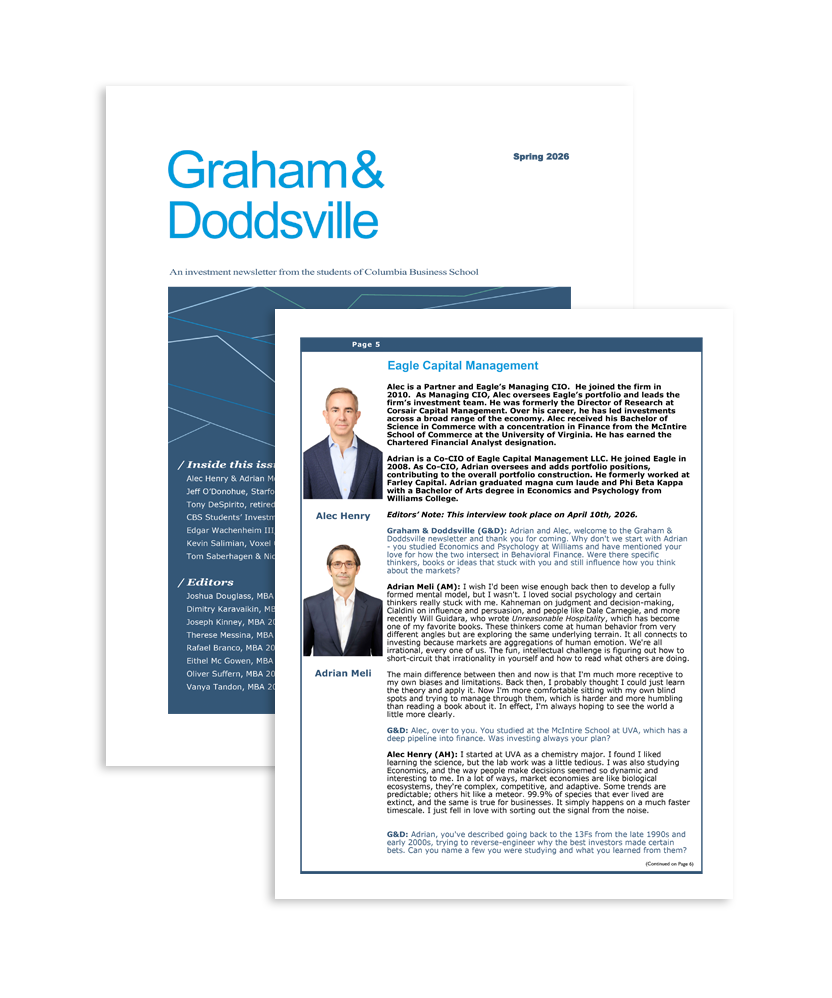
Alec Henry, Managing CIO, and Adrian Meli, Co-CIO, were featured in the Spring 2026 edition of Graham & Doddsville, the flagship newsletter of Columbia Business School's Heilbrunn Center for Graham & Dodd Investing. Below, we share select excerpts from the conversation across a variety of topics including market structure, AI, and where the team sees opportunities today. Download the PDF for the full conversation.
Read the NewsletterPassive takes price, active sets price, and that’s fine and good so long as the remaining participants are sufficiently diverse and wise.
It’s not systematic, but we are trying to understand the big changes in market structure. The important shift to be aware of now is that over the past five or six years, individual stocks and sub-sectors have become much more prone to both positive and negative overreactions.
To step back briefly, in 2020 there was no price too low for travel stocks and pandemic losers, while companies like Zoom or Peloton traded to absurd levels. To put that in context, I think Zoom at the peak had a market cap that is comparable to where SAP’s market cap is today and probably something like five times Workday’s current market cap. At the time, back in 2020, we attributed it to the market not knowing how to price a hundred-year event. Now we see it as an early indicator of this changing market structure. Then in 2021 we had the meme stock and SPAC craze. In 2022, when war broke out, we had “regime change,” and some of the internet giants, like Amazon, Meta, or Netflix, declined significantly while the commodity complex exploded higher on mostly temporary shortages. More recently, we have the AI trade and some of the AI maximalist-type claims and debates. The picks and shovels are doing great while perceived losers gap down on a Twitter post as the market tries to sort this out.
The reason you’re seeing this degree of reaction, and why it’s been magnified, is the change in market structure. Passive has taken so much share of the market; there are fewer active market participants setting price.
For any idea, there are a few fulcrum issues that will make or break the investment, and we want to make sure we have the right ones identified.
It's rare to find the right combination of great business, attractive price, and some kind of controversy or misperception where we feel like we can be variant enough to have a competitive advantage. Because a lot of the work we're doing is long-term in nature, it remains relevant for some time. An idea we work on this year may plant a seed that we can harvest in 2027 or 2028.
We try to think through normalized earnings per share five to seven years out and solve for underpriced earnings streams. We want our time horizon to be long enough that earnings growth does most of the work, and that the earnings themselves are reasonably forecastable. If you're putting a multiple on 18-month earnings, the multiple you choose drives much of the return. It strains credibility to say earnings are precisely forecastable 15 years out. Our five-to-seven-year window balances this tension.
Great firms tend to have great teams running them. Because we're an important shareholder in most of the companies we own, we typically have a good opportunity to get to know the key people. We also spend a lot of time talking to former employees to try to build a mosaic of the culture. Frequently, we like the business and the price, but we're not sufficiently confident or comfortable with management.
The goal is to update existing frameworks, not scramble to build one from scratch.
Everyone's scanning for dislocations in real time, deliberately, not reactively.
If we're doing our jobs, we've already been contemplating many possible future states of the world before they happen. When something material changes, whether it's the world itself or our understanding of a specific business, we need to take that into account.
Volatile stock prices are ultimately our friend. High prices give us the opportunity to exit; low prices give us the opportunity to buy. When you see a period of heightened volatility, the big impact is that our portfolio will likely turn over a little more than usual, because more of our names hit prices at which we want to act, whether buying or selling.
You could buy an asset that’s trading like there’s a 10% probability that the moat is still intact in 5 to 10 years, when the actual chance is much higher. You have to look at the risk-reward of each asset.
I think the market is pricing certain assets like it's almost a certainty, more than a possibility, that something bad will happen to them. And we think a lot of assets will get disrupted, but that doesn't mean it's uninteresting to look at assets that are down a lot.
Being liquid is going to be helpful because we will learn a lot as weeks and months go by. Eagle's approach is to try to have humility about this. This is a big change. Let's take a step back, look at each asset, and see what we can conclude about the way things are changing and then make the best risk-adjusted bets possible.
AI is a disruptive technology in this industry. It's deflationary for engineering costs, and it'll change many workflows for how software is used. I don't think AI is a free option for these companies. It's something that the entire industry will incorporate, and it's something that the entire industry is going to experience creative destruction from.
AI is widening the distribution of 5- to 10-year outcomes for these businesses. In some cases, the central tendency shifts to the left, and then in others it's stable or even shifts right. The entire space has sold off over the past year. Our view is that the recovery will be more heterogeneous than the decline. Many businesses will be impaired, but a number will likely benefit.
Excerpted from Graham & Doddsville, Spring 2026 · Columbia Business School’s Heilbrunn Center for Graham & Dodd Investing. Any discussion of specific companies is for informational purposes only and does not represent all of the securities purchased, sold or recommended by Eagle Capital. The reader should not assume that any investments in the companies identified and discussed were or will be profitable. Eagle Equity Composite holdings as at March 31, 2026 were as follows: AA; AER; AJG; AMZN; AON; ASML; BAYRY; CHTR; CMCSA; COF; COP; DHR; EL; ELV; EQT; GEV; GOOG/L; HLT; HUM; INTU; LBRDA/K; LEN; LSEGY; MA; MELI; META; MSFT; NFLX; PTC; SAP; SHEL; SPGI; TSM; UNH; VMC; VSNT; WDAY; WFC; and WWD. For additional information, please see the additional disclosures below and visit here.
Graham & Doddsville: Eagle Co-CIOs on… | Eagle Capital Insights
Alec Henry and Adrian Meli were featured in the Spring 2026 edition of Graham & Doddsville, Columbia Business School’s flagship investing newsletter, discussing market structure, AI, and current opportunities.